Monday, February 23, 2015
Can a Role Playing Game be a mirror of your soul ?
Friday, March 7, 2014
Android Game Recco - Card City Nights
Card City Nights is a wonderfully imaginative, addictive, and rather odd little card battling game that offers a lot more strategic depth than its goofball graphics suggest.
The game starts you off as a newcomer to the city, and very quickly has you meeting some pretty nutty characters, battling them to win cards, and setting you off on a quest to find the eight 'legendary' cards to win the game. The story, of course, is nonsensical and doesn't really matter, but the writing, should you choose to pay attention to it, is witty, charming and funny.
The core of the game is, as it should be with card battlers, fighting card battles, winning new cards and building the most powerful deck possible. The battle system itself is pretty unique and fun - you lay out cards on a 3 X 3 grid, trying to string together 'combos' to attack your opponent or raise your own defense. It's a lot more challenging than it initially looks. The first few battles are pretty straightforward, but pretty soon you'll discover a wide range of cards, combos and strategies - primarily by the time-tested method of getting your ass kicked by the game's 'bosses' who use said strategies. Soon, you'll be winning tons of new cards and putting together powerful new decks with specific strategies - I've got an attack heavy deck, a defensive deck and a generalist deck already, and I'm only about two hours in.
It's a fun, challenging and rewarding battle system - I say this as a fan of card battlers in general, and MTG and, more recently, Hearthstone in particular.
The most important game design lesson I ever learned
This one simple principle seems to be a common thread running through every successful (and especially addictive) blockbuster game ever made.
Here it is :
The action that your player performs most frequently should feel like fun all by itself.
To elaborate - the one (or two) things that the player repeatedly does while playing your game should feel juicy, satisfying and fun enough so that just simply performing this action hundreds of times even without any additional context should not become boring.
Let's test this hypothesis by looking at some blockbuster games across genres :
Super Mario Bros - running and jumping
The famously solid and weighty physics behind Mario's basic run and jump make controlling him extremely pleasurable. Just running and jumping around a level with Mario, even without any enemies or obstacles would still be pretty fun.
Diablo - clicking on an enemy
The famously visceral feeling you got when attacking a monster in Diablo - the hugely satisfying crunching, squishing and cutting sounds followed by great death animations - meant that you could just click on enemies all day, making it one of the most addictive games in history.
Candy Crush Saga - matching candies
Love it or hate it - there's no denying that Candy Crush exploded in audio-visual delight every time you made a combo. Every sound and animation is just perfect, and they string together beautifully so that making a series of long combos is a hypnotic experience - regardless of the score, progression and other gameplay mechanics.
Halo - shooting
Halo (or any other top FPS) gets the shooting right. The simple act of firing any of its guns feels solid, punchy and satisfying - the sound, the recoil animation, the overheat animation, the needler trails, all work together to make just shooting a gun a fun experience by itself, even if there are no enemies at the other end.
Farmville - harvesting crops
The core actions in Farmville are another example of using sound and animation to make addictive fun. Harvesting a bumper crop in Farmville is almost a zen-like experience - huge bushels of strawberries or pumpkins or apples (and gold coins) burst out of your screen at every click, giving your brain endorphin hit after endorphin hit.
Angry Birds - launching a bird
Like Super Mario Bros, this one is also all about physics. The superb sense of weight when you catapult different kinds of birds to their doom, with the hilariously perfect sounds, lead to an experience that never gets old, however ,many hundreds of times you repeat it.
Minecraft - digging and placing blocks
The satisfying whack-plink-thunk sounds when you dig through different kinds of terrain in Minecraft, and the comforting thud when you place a block down make the basic actions of the game feel fun and enjoyable. So hours and hours of carving out the terrain and building stuff doesn't feel like a chore - in fact, quite the opposite. It's an addictive, almost meditative experience.
Hmmmmmm. Most suspicious, yes? The truth seems to be, regardless of genre, that the most successful games make the core action as much fun as it can be. So much that, when you're in the thick of the game, it becomes a trance-like, meditative experience.
I actually learned this the hard way at Zynga when we shipped Hidden Shadows. While we focused heavily on making the hidden objects scenes look great, writing interesting stories, tuning the economy to feel right and suchlike, we dropped the ball on one important thing. In our game (like in many Facebook games), the action that the player performed most frequently was in fact clicking on buttons (in the quests, the game's various menus and dialogs and so on). We failed to make the button-clicking a delightful experience - and this made the game, in hindsight, less addictive. My gut still tells me that a better level of UI polish would have made Hidden Shadows a vastly more successful game than it ended up being. Games like Candy Crush Saga and Farmville 2 get it right - and are more addictive experiences as a result.
To anyone making games today, I cannot stress this enough - isolate the core action of your game, and polish the crap out of it until it feels like fun on its own. Test prototypes that have just the core action and absolutely no other systems built around it - and iterate until these feel enjoyable to play around with. Your game will be better for it.
Saturday, February 8, 2014
Madras Psychedelic - an Interactive story about weirdness, Madras and being lost in an alternate dimension.
The first prototype is finally here - it's called Madras Psychedelic.
This prototype is a text-only (with a few pictures) Twine based interactive story in which I'm testing out the overall feel of the narrative. Check it out here : http://img.sonofbosey.in/game/Ep1.html
Maybe sometime in the future, I'll mock up something with graphics in AGS or something. But for now, I want to see if the narrative works. Is the world fun to explore? Are the characters fun to interact with? Is the story interesting enough?
So I'd love for you guys to play through this VERY early Alpha version and let me know what you think .
Here are some teaser images to give you an idea of what's in there :
Do play, and give me lots of feedback and harsh criticism. It's over here : http://img.sonofbosey.in/game/Ep1.html
Friday, February 7, 2014
Why we're so addicted to Flappy Bird
The success of Flappy Bird seems to have confounded a lot of people, who can't seem to understand why it's such a big deal. As a game designer, I see some very sound reasons (based on core design principles) why it's so darn popular and addictive, despite being so brutally difficult. Here's what I think :
It feels winnable
The objective of Flappy Bird is very simple - "Score 1 more point than I did last time". That is all. No quests, no story, no faraway goals that seem unreachable or intimidating.
That doesn't sound so hard, does it? Surely you can do it?
Especially since you were this fucking close last time. Right? You only missed by a whisker. So you try again.
Play time is super short.
Each play lasts, for most people, about five seconds or less. Even the best players can't be playing for more than a minute. So where's the harm in trying just once more to score just one more point? So you try again.
Every small victory makes you feel Like A Boss.
Because it's so darn hard, scoring a single point gives you a feeling of epic victory and accomplishment. And the next epic win feeling is only five seconds and one point away. So you try again.
It feels fair
This is important - the basic physics and controls in the game feel solid and fair. So every time your bird falls to the ground, you blame yourself and your lack of skill. Not luck or randomness. So you still believe that you can beat it the next time. So you try again.
So by following four very basic design principles and implementing them well, the designer has created a game that is addictive. A game that people can't stop playing. A game that people talk about and get others to play. I don't think it's an accident - it is at its core a very well made game.
It isn't even the first of its kind - many recent games have achieved success by following the exact same principles. Super Hexagon, for instance. It's just that Flappy Bird takes these principles and distills them to their essence, cutting out even the most basic of embellishments, such as pretty graphics, music or a story. Which is why it works for such a wide audience. And which is why it will fade away quickly - because it lacks lasting value to anyone other than the most competitive of players.
The lesson here for anyone making games is this - the oldest video game design technique (one fun core mechanic tied to a high score ) still works very well.
Thursday, September 20, 2012
Brutality! A history of violence in videogames.
Yes, this is a piece about violence in videogames. It’s a look at the most brutal, gratuitous and vile things that you can do to your opponents (and sometimes to yourself) in some of the most controversial games in history.
But this isn’t a rant about how videogames are ruining our children, and turning them into mentally unhinged murderers who run amok, cheerfully decapitating bystanders, neighbours, cousins and school principals (videogames don’t do that, but that’s a discussion for another time and place). Oh, no. This is a celebration of very adult entertainment (not THAT adult entertainment. Drag your minds out of the sewers, if you please) provided by the fantasy violence that is the hallmark of some of the finest videogames ever made.
Violence has always been a common theme in games, even in the old days. Take chess, for instance. Nobody ever accused chess of being a bad influence on tender young minds. But it’s undeniable that it is a game about cowardly, pansy monarchs who send out troops to kill the troops of other similarly spineless despots, while they muck about safely behind the lines. With a little imagination, it’s easy to look at a game of chess in progress and see mounted knights hacking foot solders into pieces, evil priests sexually harassing beautiful queens by menacingly circling around them (sometimes hunting in pairs, like fast bowlers) and a battlefield stained with blood, bodies strewn by the wayside. Uggh. I hope I’ve convinced you to pull your innocent children out of those dangerous chess classes immediately. A most vile and corrupting influence, this game. Turns your children into corrupt generals, murdering soldiers and deviant priests. Shudder.
But I digress.
Videogames, in fact, started off fairly innocently. The very first videogame, Pong, was nothing more than a friendly game of electronic tennis. But it didn’t take very long for the corrupting influence of traditionally violent games like Chess to find their way into videogames, and before long, we had spaceships shooting laser beams at each other, crazed gorillas carrying off pretty girls, and then being attacked by plumbers carrying hammers, strange pizza-like creatures defending themselves against monsters by actually eating them raw, and other such gory goodness. But videogames such as Space War, Donkey Kong and Pac-Man were still perceived as wholesome entertainment - because, like Chess, they hid their darkness behind cutesy-pie facades. Nobody looked at Pac-Man gobbling up a monster and saw it for what it was - cannibalism. Without even the decency to cook your fellow creatures before eating them. (I’m personally shocked that Pac-Man did not set off a wave of cannibalism in the United States when it first came out. Maybe there weren’t enough anti-videogame campaigners at the time to spark it off.)
So people did not quite get offended by videogame violence for a while. Not until Death Race arrived in 1976.
Death Race was a game in which you drove around in a sports car and ran over innocent pedestrians for points (this makes it even more cynical than the much reviled Grand Theft Auto, which doesn’t explicitly reward this soul-cleansing activity). To make it worse, every time you successfuly ran over someone, a cross would appear, marking the spot where they once stood. People in America were so horrified by this, they even forgot that it was based on a movie featuring David Carradine and Sylvester Stallone (a most heinous crime by itself), and started complaining en-masse about how the game was ‘sick’ and ‘morbid’, triggering off TV debates on the psychological impact of violent videogames, and raking up all manner of controversy that eventually caused Death Race to sell many more copies than it would have otherwise.
It’s important to remember that Death Race (and other controversial games of the time, such as Custer’s Revenge and Texas Chainsaw Massacre) featured graphics that were extremely primitive, and a far cry (see what I did there?) from today’s games. If you were to watch a game of Death Race in progress today, it’s highly unlikely that you’d find it even in the least bit disturbing.
However, you’re unlikely to have that problem with Bulletstorm.
The recent first person shooter from Epic, controversially advertised as “the game your mom doesn’t want you to play”, encourages players to ‘Kill with Skill’ - awarding special points for creative ways of disposing off your enemies, such as lassoing them and then impaling them on metal spikes, kicking them on to live wires and electrocuting them, and pulling them off helicopters and then shooting them in the ass before they hit the ground (I kid you not). This game is so over the top, it makes Grand Theft Auto look like a game of tic-tac-toe. It’s re-ignited the debate over violence in games all over again, and given Jack Thompson one more reason to regret that he’s disbarred in practically every state in the US.
But the important thing is this - Bulletstorm and its ilk aren’t meant for kids. The Electronic Software Ratings Board (a body that was formed thanks to Mortal Kombat’s famous spine-ripping, neck snapping fatalities) has had the good sense to rate these games ‘M’ for Mature, meaning that only persons aged 17 or above can play it. And if you’re 17 or above, there’s some incredible good times to be had with extremely violent videogames.
And let’s face it - we live in a violent world, and there’s little evidence to show that it’s going to get any gentler or kinder overnight. The make-believe violence found in videogames is simply play - an extension of the bang-you’re-dead popgun play we all indulge in as children. Renowned writer Gerard Jones, in his famous book ‘Killing Monsters : Why Children Need Fantasy, Super-Heroes and Make-Believe Violence’, makes an eloquent, well-researched and convincing argument that fantasy violence actually helps children deal better with the many kinds of violence they face during childhood, and as adults later in life. Indeed, children relate to make-believe violence ( such as that found in videogames, comics, cartoons and films) completely differently from how they relate to it in news broadcasts or when faced with it in real life. And this distinction stays with us through adulthood (at least, those of us who aren’t mentally unhinged), which is why we can enjoy violence without indulging in violent behaviour - why we realize that it’s probably not a good idea to respond to a power cut by ripping off a bright friend’s head to use as a light source, or to react to the high prices of foodgrain by spraying bullets around the local Big Bazaar.
If you still believe that videogame violence is evil and will make you behave violently in real life - then a piece of heartfelt advice. Don’t play chess.

Grandma Gamer
Or how the gift-request killed the headshot.
Grandma really needs to kick her videogame addiction.
Oh? You thought we were talking about teenage boys? Heavens, no.
The world is seeing the rise of a new kind of gamer. She’s anywhere between her thirties and seventies, and couldn’t care less about oversized orcs, perilous planets, swashbuckling swordsmen, super-soldiers and all the other stuff that have historically defined videogame-cool. She’s far too busy tending crops, caring for animals and making cities look pretty. Yep. That friend on Facebook that keeps asking you to help her bake cakes or build a day-care center? That’s her. And she’s ushering in a revolution that is shaking the hitherto testosterone fuelled world of videogames at its very foundations.
The growth of social gaming is old news. Powered by the likes of Farmville, Cityville and The Sims Social, games on Facebook and other social networks are perched cheerfully right atop the gaming heap. These games command the kind of following that all but the most elite of hardcore franshises can only dream about. Consider this - blockbuster hit Grand Theft Auto IV has sold 22 million copies in over three years since its release. Cityville has over 70 million people playing it every single month. Pwnage, gamers would call this.
But we’re not here to toss numbers around to prove who’s winning. No no no. That would be like bringing a flamethrower to a food fight.
We’re talking about something far more profound. We’re talking about the age of happy. The era of glad. ‘Tis a time to be jolly, hold hands, skip around and generally annoy the crap out of others by being overwhelmingly friendly. And the new gamer chic is the looneytunestechnicolorcandypop aesthetic of the social gaming world.
It’s different, this gamer world. A far cry from the trash-talking world of flying fists, exploding heads, aliens with dubious motives and scantily clad warrior-princesses we core gamers know and love. Violence, anger, sex and mad skillz are being replaced by [shudder] love, caring, playing with dress-up dolls and virtual duplo, and [shudder] being nice to other gamers. You’re not s’pposed to be NICE to other gamers. You’re s’pposed to blow them to bits. Whatever happened to tradition? It was instagibbed by the neighbor request, that’s what happened.
The colourful, happy, bouncy and, crucially, friendly and welcoming world of social games has changed the dominant vocabulary of gaming. Gift requests, helping friends and inviting neighbours are pushing headshots, deathmatches and clan raids into cult status from the cushy environs of the mainstream. This new kind of game is like a big, warm hug. It welcomes everybody. Grandma loves this - which is why she’s taking to these games like a duck to water. And other ordinary people just like her are loving it, too. And you know the thing about ordinary people? There are zillions of ‘em - which is music to the ears of biggie game publishers.
The world has always looked at games as things that are played by ‘gamers’ - as though gamers weren’t human beings but some strange other-worldly life forms. Then somebody (it was probably Will Wright, that wonderfully mad coot) realized that ordinary people didn’t play games because nobody made games that they’d want to play. And they realized that games didn’t necessarily need to be epic adventures that required godlike reflexes in order to be fun. They just needed to be fun, period.
A Sims, a Farmville and a Cityville later, here’s where we are.
What’s happening here is nothing short of a grassroots revolution in the world of videogames. It’s never been more exciting - all sorts of new games are popping up, enticing newer and newer audiences to generally slack, ignore their duties and spend time playing. Good thing, that.
And while, at first glance, it may seem that gaming’s latest revolution is bypassing its hardcore faithful in favour of the new kids (and grandparents) on the block, all is not lost. The creative, positive gameplay vibe from social games is having ripple effects on hardcore games as well. The result? Games like the phenomenal Minecraft - which can be best described as Lego with monsters. Minecraft is essentially about creative sandbox play - build a world with blocks. They just put the monsters in to make it more exciting for core gamers - but Minecraft at its deep core has more in common with games like Farmville than with any hardcore genre from the past. Beneath its hardcore skin of a first-person perspective and retro graphics is a game that is essentially about building things, and enjoying watching your creations grow, little by little. It’s like playing with toys.
Be sure - there is a convergence afoot here. According to a report by gaming website Raptr.com, 30% of XBOX owners, who nobody would accuse of being anything less than hardcore, also play games on Facebook, up 10% from the previous year. Increasingly, people are playing a wider spread of games.
This convergence is actually heading to a happy future where the word ‘gamer’ will stop meaning ‘anyone who enjoys playing videogames’. We don’t have specific words for people who enjoy reading books or watching movies as a matter of course. Sure, we call the obsessive types ‘bookworms’ or ‘couch potatoes’ or ‘Roger Ebert’, but those are outliers. ‘Gamer’ should mean ‘someone who obsessively plays every single game ever released, even Big Rigs’ and not ‘someone who enjoys a bit of Halo and Super Mario Bros on weekends’. And Grandma and her friends are helping us get there.
You know what I want to see? A scene where Grandma spends an hour accepting neighbor invites and neighbor requests, tending to farms and cities, before saying “Maybe I should try that new game about that dear little boy running around with a plasma cannon. My grandson says it’s fun.” She calls out to the kid, asking him to show her the latest sci-fi FPS. And the kid shoots back “Later, Grandma. Need to harvest strawberries.”
That would be pwnage.
Holy Cow!
A sideways glance at the most stellar performances by cows in videogames.
Ragequit!
Some games just make you want to throw your controller at the wall.
Videogames weren't always this way. They didn't always mollycoddle you with 'easy' modes, automated save points, helpful tutorials and sissy automaps.
Monday, October 17, 2011
Gamer Journal : Deus Ex, Rage and From Dust
Here's the report :
Deus Ex : Human Revolution
Finally got to spend some quality time with the augmented edition I bought. Mixed feelings.
It's Deus Ex - so we do have an interesting story. The augmentation system seems interesting and well thought-out. The stealthing is pretty decent. The conversation / persuasion mechanics are also pretty cool.
But here's what I didn't like :
- The gunplay is all over the place. The game bumps you into third person view when you're in cover, and back into first-person when you pop out of cover. This makes for some very awkward moments during firefights and leaves you scurrying about frantically. The whole cover / shooting system is poorly implemented, and the level design doesn't help - forcing you into situations where you can't play purely as an FPS, nor purely as a cover shooter. The entire combat experience is frustrating and clunky, and also unavoidable. Sure, if you're really, really good, you can sneak through entire levels - but you'll eventually come across a boss fight that you can't avoid. It's pretty bad design - directly impacting the core experience.
- I'm about seven hours in, and the gameworld is unconvincing. Walking around Deus Ex's Detroit, I never got the feeling that I was exploring a city. It felt more like a movie set. Wandering around a gameworld, you need to feel that the world around you is real - the places and people should feel like they've been here for ages before you arrived, and go about doing their thing even when you aren't around. A living, breathing world. And there are plenty of games which do it perfectly well - Red Dead Redemption, New Vegas, GTA to name a few. But Human Revolution fails here. I never got any feeling other than the fact that I was exploring a game level with game characters. Perhaps sacrificing the free-exloration in favour of separate levels with loading screens may have lent a sense of distance between locations and fleshed out the illusion better ? But as it stands, Detroit in Human Revolution is simply too small and claustrophobic to be a convincing open world.
RAGE
Boy Oh Boy! I'm enjoying this one.
Got it running on my desktop - runs beautifully with everything maxed out on my Core i9 powered rig with a two-year old GTX 295 2Gig card, on Vista (yes, yes, I know). Sure - still has some random pop-in (but not nearly as much as on the lapop) and occasional tearing, but nothing that breaks the game.
It looks great, the world seems huge, and the gunplay and vehicle combat have a nice, solid (and slightly old school) feel to them. Which is kinda why I like it. RAGE isn't the most thought-provoking or innovative or cleverest of games, but it nails the fun factor. Driving around and killing things is great fun in RAGE, and isn't that what a shooter should be? It's the exact opposite of Deus Ex, in that it's a game that doesn't try to do too many things, but keeps it simple and does it well.
Five hours in - just reached Wellspring and completed a few quests. Loving it so far. Oh - and Wellspring actually feels like a real place - with personality, a history and a sense of life. Again, nails something that Deus Ex fails to do. Plus - RAGE has a (barely) hidden tribute to Fallout. \m/
From Dust
Just got started with this one - on XBOX. It's rather beautiful to look at, and features some interesting terraforming mechanics. Reminded me of an ultra-modern Populous variant. But I played only past the first tutorial level, and so can't really comment on how good the actual game is. More soon enough - plan to spend more time with this by the next weekend.
P.S. Stopped numbering the episodes. It was foolish to begin doing it in the first place. So hence. Er. Ah.
Tuesday, October 11, 2011
The Humble Frozen Synapse Bundle is here
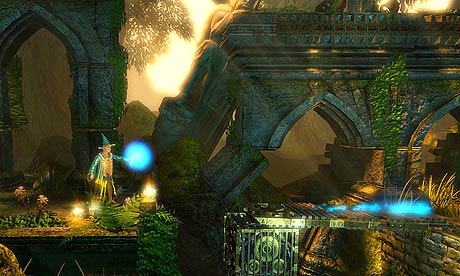
What's more, pay more than the average price, and get the Humble FrozenByte Bundle for free - it includes the brilliant Trine, Shadowgrounds and Shadowgrounds : Survivor, an interesting prototype of a game called Jack Claw, and a preorder of the upcoming Splot thrown in, too.
Hurry on up and grab it.
Sunday, October 9, 2011
Gamer Journal Ep 3 : Everlands HD is a deceptively deep strategy game.
Spent a couple of hours playing Everlands HD on the tablet. It's a brilliantly addictive little strategy game - with gameplay that is far deeper than its cutesy animal fiction suggests.
Gameplay proceeds by placing pieces on a hexagonal grid and capturing the opponent's pieces. Each piece (animal) has an attack and defense power, and some additional properties like bonuses, initiative and powers. Based on these simple rules, Everlands HD offers an engaging and addictive experience. If you have a droid or iOS device, well worth a try.
A few design takeaways :
Fiction layer
Like most games, the fiction layer in Everlands HD has nothing whatsoever to do with its core game mechanics. If, instead of cute and colorful animals trying to rescue the forest, it featured marines, tanks and aliens in a bleak wasteland, the game would appeal to a completely different audience with absolutely no change in gameplay. Designers sometimes get too caught up in the fiction-gameplay dynamic and end up making games that lack tight focus. My take ? Nail the gameplay and you can always rewrite the fiction.
Winnability
Everlands HD is challenging but fair. You will lose repeatedly but always try again - because the game clearly demonstrates that :
1. You lost because you made mistakes, not because the game is unfair.
2. If you play more, you will improve.
3. If you play skilfully, you will win.
It's a design principle that makes for great games when followed.
P.S. This is the first reasonable length post typed out entirely on my tablet. Typing on the Xoom is pretty neat if you're using a cool little app called Thumb Keyboard.
Saturday, October 8, 2011
Bigfatphoenix's Gamer Journal - Ep 2 : Cave Story, NOVA 2
It looks like a fairly innocuous 2D platformer at first, but stay with it for a while, and Cave Story offers an excellent experience - an austere, surreal and emotional story that is quintessentially Japanese, rock-solid platforming mechanics that make it great fun to run around and shoot all sorts of weird monsters, and some very imaginative level design.
However, the take-away mechanic for me from Cave Story is the run-and-gun leveling mechanic. Your gun levels up as you rack up more kills, and starts firing off increasingly powerful kinds of blasts. However, take damage and it will lose levels, and get back to firing wimpy pellets. It's a mechanic that rewards 'being in the zone', something classic skill gamers will instantly recognize. You grow more powerful as you play more dexterously, evading scores of enemies and racking up kills. Lots of games do offer similar ideas - the special meter in fighting games, for instance - but the powered-up weapons in Cave Story are so much fun to use, it's a genuine incentive for high-skill play (Man, the return of classic skill gaming is something that delights me no end.)
-----------------------------------------------------------------------------------
Also tried out NOVA 2 for Android on my Motorola Xoom. The Tegra 2 powered graphics make this unabashedly Halo-like FPS look pretty stunning. Take a look :
But crap controls. All three control schemes provided are simply too unwieldy on a tablet device, at least for me. It's clearly been designed for smaller phone screens, where I can see the twin-touch or the gyroscope controls working fairly well (due to the smaller screen real estate, as well as the device being far lighter) - but it's a horrible mess on tablets. I've seen a bunch of reviews on the Intertubes that rave about how great NOVA 2 is on tablets, but I simply cannot see why. I'll try again a few more times to get the hang of it and see if there's something I'm missing (also because the game itself looks like it could be a lot of fun) - but colour me skeptical for now.
A couple of points, then :
- I hate on-screen analog sticks. They suck. They're a cop-out. Deal with it.
- I'm not sure about shoehorning existing game designs control schemes from one platform on to others which use completely different control paradigms altogether. Shouldn't we be thinking "how do I make games that would be fun on tablets?" instead of "how do I put Halo on a tablet?" ?